 Core Cutting Machines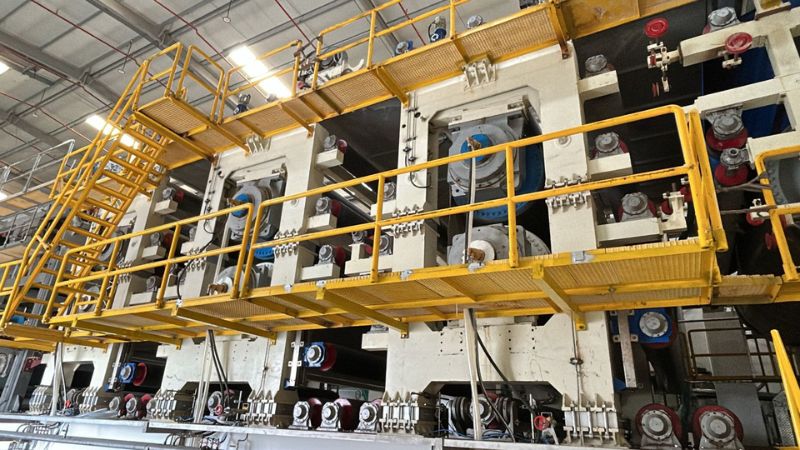
Overview
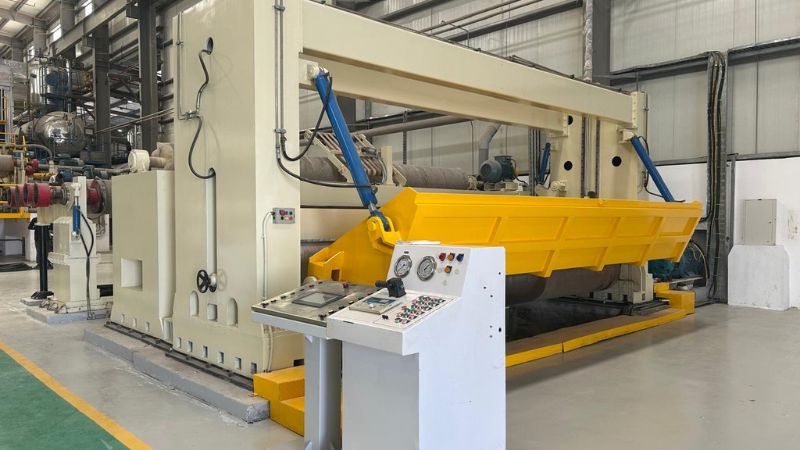
Our press part solutions are engineered for maximum water removal with optimised sheet strength. Jumbo presses support linear loads up to 400 kg/cm for high-efficiency dewatering. Bi-nip and tri-nip press options provide flexibility for different paper grades. Higher dryness levels reduce steam consumption in downstream processes.
Press parts in kraft and tissue paper machines mechanically remove water from the wet web post-forming, boosting dryness from ~20% to 40-50% via high-pressure nips, with Jumbo (up to 400 kg/cm load), Bi-Nip, and Tri-Nip designs optimising efficiency.
Applied in Fourdrinier setups for kraft liner/corrugated medium (higher loads) and tissue (gentler pressing), using felts to sandwich and compress the web through sequential nips.
Scope of Delivery
- Jumbo Press - Includes heavy-duty cast iron/stone rolls (up to 1600mm dia., hydraulic loading to 400 kg/cm), press felts, frame with bearings, nip control hydraulics, lubrication system, and safety guards.
- Bi-Nip Press - Covers two-roll configuration (rubber-covered rolls, 1200-1400mm dia.), felt rolls/guides, suction pick-up roll, double-felted nips, pneumatic/hydraulic loading, doctor blades, and basic automation controls.
- Tri-Nip Press - Features three sequential nips (incl. shoe press option), grooved/suction rolls (up to 1500mm dia.), extended felt runs, vacuum systems, advanced nip sensors, frame assembly, and shower pipes.
Key Advantages
- Jumbo Press (up to 400 kg/cm): Delivers ultra-high linear loads for superior water extraction (up to 50% dryness), reducing dryer steam use by 4% per 1% dryness gain; ideal for heavy kraft grades with uniform density.
- Bi-Nip Press: Two sequential nips enhance dewatering and sheet consolidation at moderate speeds, improving fibre bonding, smoothness, and energy efficiency for tissue and linerboard.
- Tri-Nip Press: Three nips provide maximum dryness (1-3% better than bi-nip), higher speeds, and strength for absorbent/thick papers; suits multi-grade kraft/tissue lines with shoe presses for extended dwell time.
Increases production capacity, paper tightness/strength, and runnability while minimising energy costs across configurations.